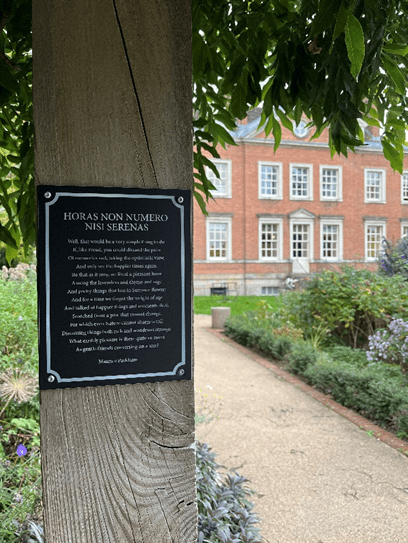
You will find Dad’s sonnet in the memory garden in Horsham park. I don’t believe in an afterlife and I’m inclined to cringe when people talk to their dead relatives in books or television dramas. None the less, I often find myself drawn to the park bench beneath Dad’s poem after my daily swim. Of late, I’ve even found myself begging him for a good idea for a new book. He hasn’t come up with one yet!
It’s been over seven years since he died. I didn’t cry at the time; strangely, not long afterwards, I sobbed my eyes out when our elderly cat was put to sleep. Although nothing I ever wrote was anywhere near the grim hospitalised reality, I had prepared for Dad’s death more than once in my fiction. Grief never overwhelmed me. It boiled over once perhaps in a pointlessly acrimonious argument about assisted dying with some dear friends. The process has been more like an anaesthetic which has taken over half a decade to wear off. These days, I miss him more and more.
Last week on a school visit, I was asked who inspired me most to become a writer. I replied unhesitatingly, ‘my Dad’. Dad spent most of his working life as a history teacher, but his true love from the age of fifteen was writing. (As a solicitor’s office boy, he wrote short stories in the ‘inhospitable’ lunch hour.) That’s why when I went to get his death certificate, it was important to me to record his occupation as ‘writer and teacher.’ Or was it the other way round?
Dad started as a playwright, his first professional work being a 1957 production of his play ‘A Sea Change’ at the Theatre Royal Margate, but in later life also wrote adult and children’s fiction and several pieces of autobiography. Somewhat to my shame, or so I thought afterwards, my answer on the school visit concentrated rather on the negative aspects of his literary life – as he often did himself. I recalled how, unlike today where rejection comes in the form of a terse (and often disingenuously upbeat) email, rejection in the 1970s meant the dull thud of a brown foolscap envelope with a playscript inside landing on the welcome mat – and that Dad was best avoided for an hour or two.
I did talk about my pleasure in the fact that one of my best-selling books (the German translation of comin 2 get u – now in its 14th edition) has a whole sub-plot based on Dad’s experiences as a young sailor in the Royal Navy in WW2. But I should also have the mentioned the unforgettable holiday in the Scilly Isles where I learned to swim, paid for by the sale of his radio series to the BBC or my pride when our fourth-year junior teacher wheeled the radio into our classroom so we could listen to Dad’s latest play on Afternoon Theatre.
Whilst adamant that that you could never teach someone to write, Dad was always encouraging when I did produce something. Aged about 8, I experienced my first literary trauma when our cat Zippy ripped to pieces a story I’d written. Not a patient man when it came to my left-handed attempts at woodwork, Dad helped me recreate the story and typed it out for me on his trusty Remington.
And I couldn’t help but pick up a few tips along the way. When my sister and I were children, he’d often ask us things like, ‘why do you suppose that man is wearing that hat?’ or ‘tell me that person’s life story. Are they happy do you think?’ Ironically, another thing that proved useful was Dad’s intransigence when it came to making changes to his work. ‘A writer knows better than anyone else what his writing means.’ Sometimes a gate keeper (agent, producer, editor) would express an interest in his work provided he was prepared to make a few alterations. Dad always refused. It was a useful lesson, I’ve not only learned to make changes whenever required, but also that they sometimes make your work better!
But probably the main thing I learned from him was the importance of perseverance. Dad never gave up. Even in his nineties, having never quite mastered the mysteries of email and only getting his first computer at the age of 80, he often asked me to send sample chapters and synopses to prospective agents and publishers. So, when my first published novel was rejected by well over fifty agents, it didn’t seem like such a big deal. And now his grandchildren are writers too. One is about to submit a first novel; another writes musical theatre. I know their Granddad’s example has inspired them both.
 Simon Packham